

Engineering
Understand the process before you change the process.
Advanced engineering, simulation and process optimization for aluminium extrusion. Industrial engineering know-how, numerical simulation and process understanding, applied before anything is changed on the shop floor.
Simulate | Understand | Optimize | Improve
- Simulate
- Understand
- Optimize
- Improve
Engineering beyond drawings
Engineering should solve production problems.
Modern extrusion plants are increasingly complex. Higher productivity, tighter tolerances, demanding alloys and more sophisticated profiles leave less room for trial and error.
For ECONS, engineering is not limited to drawings, calculations or machine design. We look at the interaction between every part of the process and use engineering tools to understand how a change in one part influences another.
- Machine
- Tooling
- Profile
- Process
- Temperature
- Cooling
- Material
- Automation
Where we support
- Concept engineering
- Equipment and process engineering
- Technical calculations
- FEM analysis
- Thermal simulations
- Process simulation
- Equipment optimization
- Existing-machine evaluation
- Revamp and modernization engineering
- Interface engineering
- Layout and integration studies
- Production-problem analysis
- Process parameter optimization
- Engineering support for new investments
The objective is not simply to calculate. The objective is to make the process predictable.
Simulation before modification
Reduce trial and error on the shop floor.
Many production problems are traditionally solved through repeated plant trials: change a parameter, run a profile, inspect the result, modify the setup, try again. That approach consumes production time, energy, material and engineering resources. Simulation analyses the alternatives before physical changes are made.
Cooling-line development
Support the engineering of new cooling concepts.
Existing quench optimization
Analyze existing cooling-line settings and alternatives.
Process speed optimization
Evaluate the relationship between cooling strategy and puller or extrusion speed.
coolEx
Understand the cooling. Control the process.
From FEM analysis to extrusion-specific cooling simulation. ECONS Engineering combines numerical analysis with real extrusion-process knowledge to turn complex technical behaviour into practical production improvements.
Cooling should be engineered. Not guessed.
FEM analysis
Understand before you modify
Thermal simulation
Visualize the temperature field
coolEx
Extrusion cooling optimization
Process engineering
Turn results into production improvements
Executive value
Better engineering creates better economics.
Less trials
Reduce development effort on the extrusion line.
Less scrap risk
Understand problematic temperature gradients earlier.
Faster development
Evaluate cooling concepts digitally before physical testing.
Higher process knowledge
Transform operator experience into structured engineering data.
Better productivity
Investigate cooling and speed as one process.
Better investment decisions
Evaluate cooling concepts before modifying or purchasing equipment.
Engineering
From FEM analysis to extrusion-specific cooling simulation.
Bring us a process problem, a new cooling concept or an existing line that should perform better.
coolEx
Engineering Intelligence for Better Profile Cooling.
Simulate. Understand. Optimize.
Cooling is one of the most critical stages in aluminium extrusion. Complex profile geometries contain very different wall thicknesses and thermal masses. If individual areas cool at different rates, large temperature differences can develop across the profile cross-section — increasing the risk of unwanted distortion and making process optimization difficult.
coolEx helps extrusion plants understand what happens inside the profile during cooling — before valuable production time is used for shop-floor trials. Developed specifically for intensive cooling sections downstream of extrusion presses, it enables fast thermal simulation of aluminium extrusion profiles through a structured, operator-oriented workflow.
Cooling should be engineered. Not guessed.
Instead of adjusting quench parameters by trial and error.
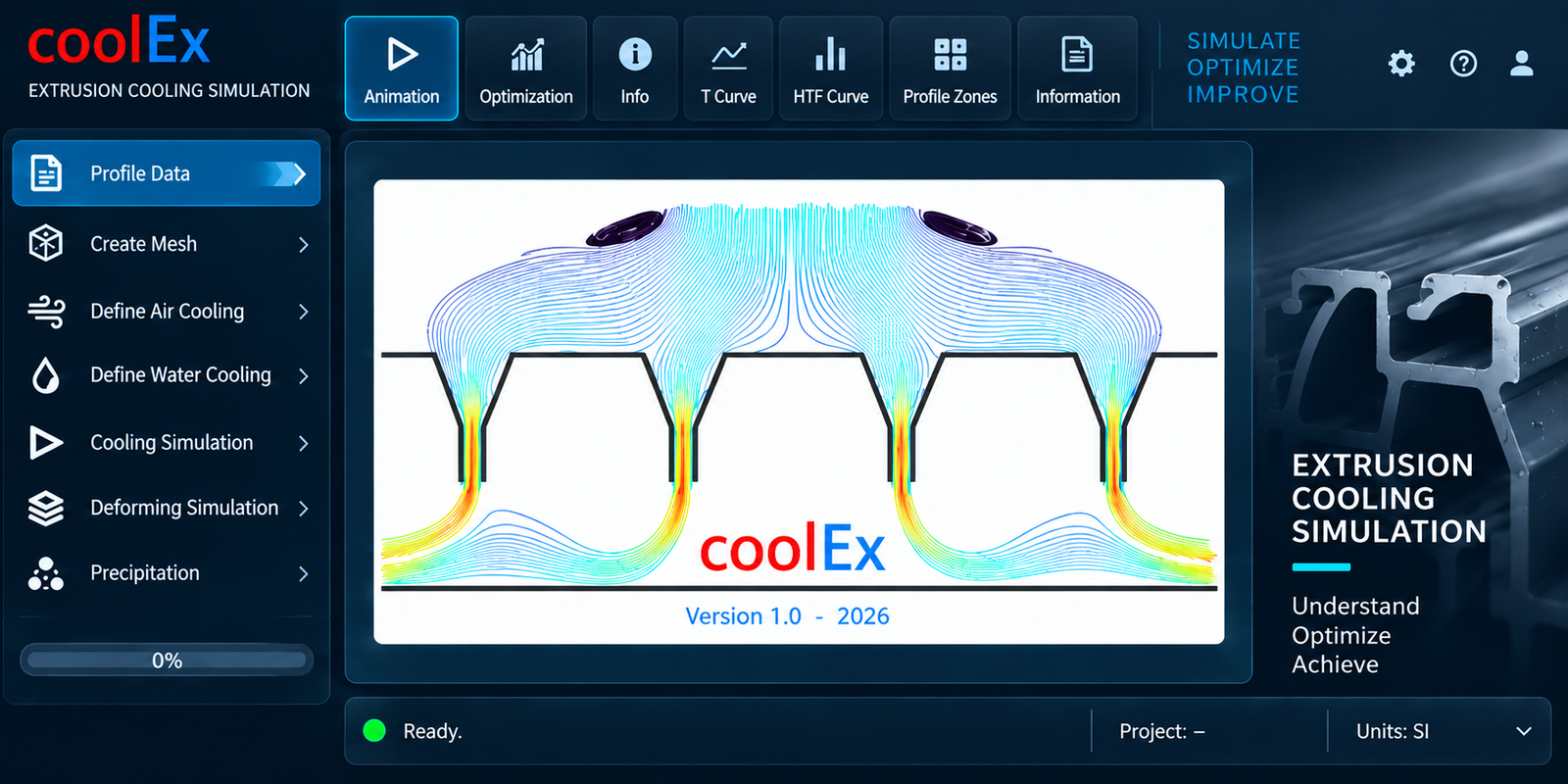
Instead of adjusting quench parameters by trial and error, coolEx allows engineers and production teams to virtually investigate different cooling strategies. Profile geometry is imported into the software, the required FEM mesh is generated automatically, and the cooling process is simulated based on the selected production parameters.
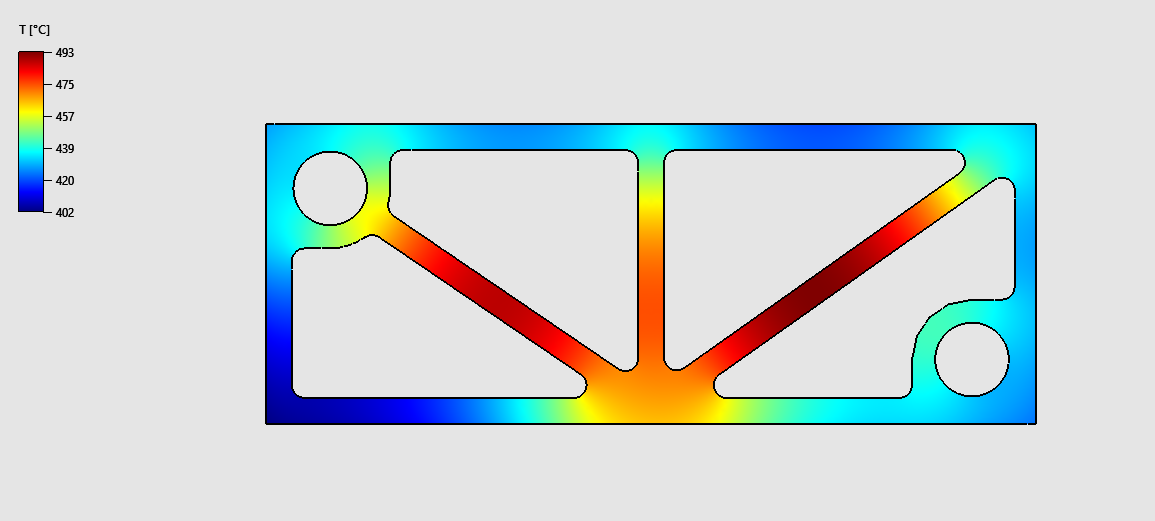
Within seconds, coolEx displays
Temperature Distribution
The temperature field across the whole profile cross-section.
Minimum Temperature
Where the profile cools fastest.
Maximum Temperature
Where the heat remains longest.
Cooling Curve Over Time
How the temperature develops through the cooling period.
The result is a clear visual understanding of where the profile remains hot, where it cools rapidly and where the cooling strategy may need improvement.
One profile. Multiple cooling strategies.
One profile. Multiple cooling strategies.
- Intensive Air Cooling
- Water Spray Cooling
- Multiple Cooling Zones
Cooling intensity can be adjusted individually for the top, bottom, left and right sides of the profile, with rates from 0–100%. Water-cooling configurations can also use different nozzle characteristics and individually defined cooling zones.
This allows different process concepts to be evaluated before they are tested on the actual extrusion line.
Don’t just simulate. Optimize.
Don’t just simulate. Optimize.
The dedicated Optimization function allows cooling parameters to be changed systematically and compared.
Simulate → Analyze → Modify → Compare → Optimize
Optimization variables can include
- Cooling Intensity
- Cooling Zones
- Cooling Type
- Cooling Time
- Puller / Extrusion Speed
Each optimization run can generate a result file containing the key process parameters and conclusions.
Why coolEx?
Why coolEx?
Less Trial and Error
Evaluate cooling strategies before using valuable extrusion-line time.
Better Temperature Uniformity
Optimize cooling parameters toward a more uniform temperature distribution across the profile cross-section.
Reduced Distortion Risk
Identify unfavourable cooling differences before they become a production problem.
Faster Profile Development
Compare cooling concepts digitally before extensive physical trials.
Lower Development Cost
Advance optimization can reduce time and cost during process development.
Better Process Knowledge
Turn operator experience into structured, visual engineering information.
From geometry to process decision.
From Geometry to Process Decision.
01 — Import
Load the profile geometry in DXF or supported alternative formats such as STEP.
02 — Mesh
Automatic FEM mesh generation.
03 — Define
Enter starting temperature, cooling parameters and cooling time or process speed.
04 — Simulate
Calculate the temperature development across the profile.
05 — Optimize
Compare alternative cooling strategies and identify improved parameter combinations.
See more than the exit temperature.
A single temperature value cannot explain the complete cooling process. coolEx allows the temperature field to be visualized throughout the simulated cooling period and lets the user inspect temperatures at individual positions within the profile.
See where the heat is. Understand why the profile reacts. Optimize how you cool it.
Beyond thermal simulation.
Beyond Thermal Simulation.
Advanced coolEx development also extends the engineering concept beyond temperature visualization. Based on the simulated temperature field, advanced functionality is designed to identify areas where temperature gradients may lead to plastic deformation. The underlying concept includes aluminium alloy data ranging from the AA1xxx to AA7xxx series.
For heat-treatable alloys, the development concept also includes visualization of areas potentially affected by unwanted Mg₂Si precipitation due to insufficient cooling. This is intended as a qualitative assessment to support further process optimization.
coolEx
From Simulation to Shop-Floor Improvement.
Less trial. Better understanding. Smarter cooling.
Less Trials
Optimize before production.
Temperature Field
See what happens inside the profile.
Multi-Zone Cooling
Air & water simulation.
Optimization
Turn simulation into better process settings.
Cooling should be engineered. Not guessed.